Specify the essentials
The agent builds a structured request from goals, skills, constraints, waypoints, or trajectory segments. Decisions left open become variables for the planner.
Supplementary material for peer review
Prescribe the tool motion to free the block. Then ask for the goal.
This video could not load. Open the MP4.
Specify what matters. Let the planner complete the rest.
SPROUT lets agents combine goals, skills, constraints, and motion in one request, choosing the level of detail each task needs.
Agentic manipulation requires reasoning over semantic task structure and continuous robot motion. Existing robot interfaces determine which decisions an agent can express and which it must resolve explicitly. High-level skill interfaces restrict task coverage, while detailed low-level motion generation imposes substantial inference cost and is more prone to geometric errors. We introduce generalized planning interfaces (GPIs), which let agents specify what a robot should achieve and how it should act, at any level of abstraction. Agents flexibly combine declarative goals and motion constraints with imperative skill sequences and fully specified trajectories.
We instantiate a GPI with SPROUT (Sampling and Pooled Refinements of Underspecified Trajectories). SPROUT interleaves spatiotemporal constraint-graph synthesis with sampling and optimization, preserving agent-defined goals and constraints, while supplying the physical variables and constraints needed for execution. Compatible numerical queries are pooled across heterogeneous graphs for GPU execution. Across eight simulated tasks with three scenes each, SPROUT achieves a 29 percentage point increase in success, compared with less flexible agent-robot interfaces. SPROUT enables agents to solve complex multi-step manipulation tasks, reasoning at the level of abstraction required for the task.
Method
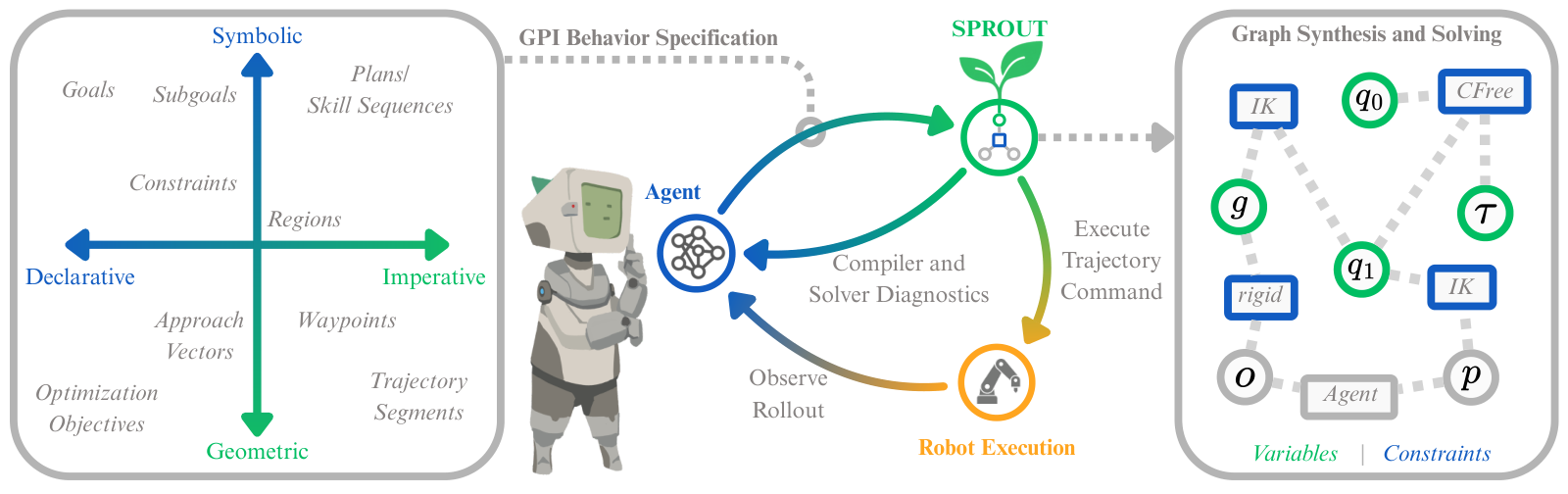
A goal is enough for some tasks. Others need a particular grasp, an orientation constraint, or an exact tool trajectory. A GPI lets the agent mix these specifications.
 Expand figure
The agent builds a structured request from goals, skills, constraints, waypoints, or trajectory segments. Decisions left open become variables for the planner.
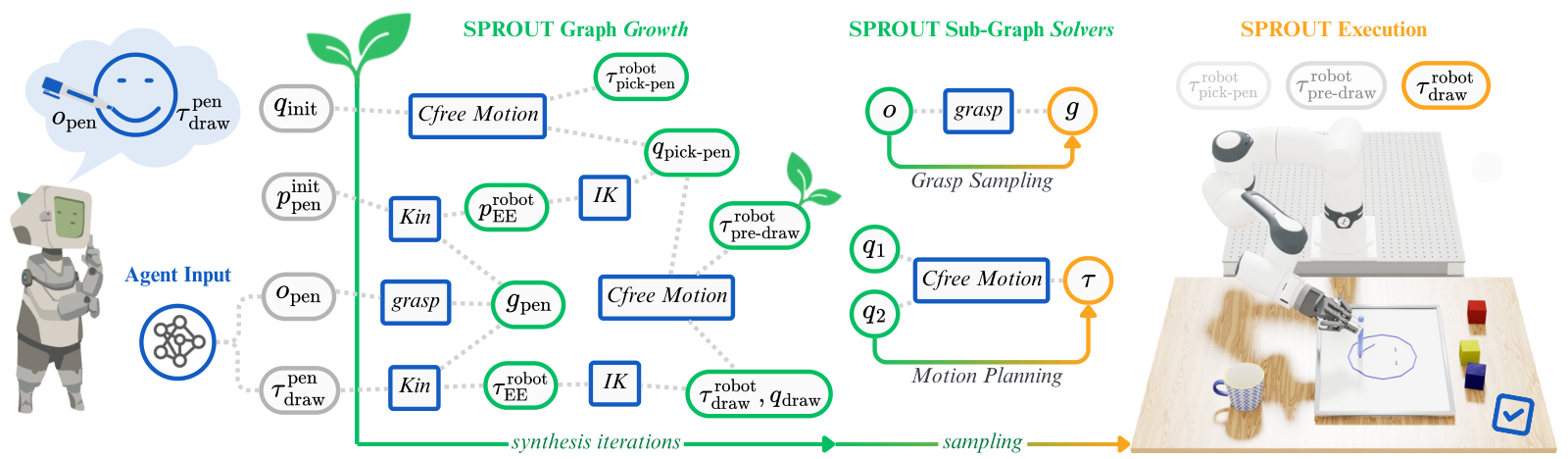
SPROUT synthesizes candidate constraint graphs, introducing actions and physical constraints while preserving the agent’s requirements.
Sampling and numerical refinement solve the remaining choices. Compatible queries are pooled on the GPU. Execution observations inform the next request.
For a drawing task, the agent can specify the pen path and let SPROUT find the grasp, approach, and robot motion. For object placement, a relational goal may be enough.
Combine levels within the same request.
Figure 3, in motion
Sampling and refinement find values that satisfy the graph while preserving the agent’s requested pen path.
4 supplied values
8 completed variables
7 constraints
Scroll horizontally to explore the full graph.
 Pick the pen→
 Approach the board→
 Follow the pen path
A task-level goal prepares the surface; a pen trajectory defines the drawing.
This video could not load. Open the MP4.
Evaluation
Eight manipulation tasks, three scenes per task, and the same agent across four interfaces. All reported benchmark results are from simulation.
SPROUT completes six of the nine instances involving toast preparation, whiteboard drawing, and tool-assisted retrieval. The other interfaces record no successes on those nine instances.
The interface leaves routine geometric choices to the planner while allowing the agent to prescribe motion when the task demands it.
Success counts follow Section 5 and Figure 5 of the paper. A task family with a success may still have failed scenes.
| Agent–robot interface | Successes | Rate |
|---|---|---|
| End-effector control | 4 / 24 | 16.7% |
| Skill + end-effector API | 9 / 24 | 37.5% |
| Task and motion planning | 9 / 24 | 37.5% |
| SPROUT | 16 / 24 | 66.7% |
The agent can spend its reasoning on the task-specific decisions and delegate geometric completion to the model-based planner. The timing results show that balance alongside the tasks each interface can solve.
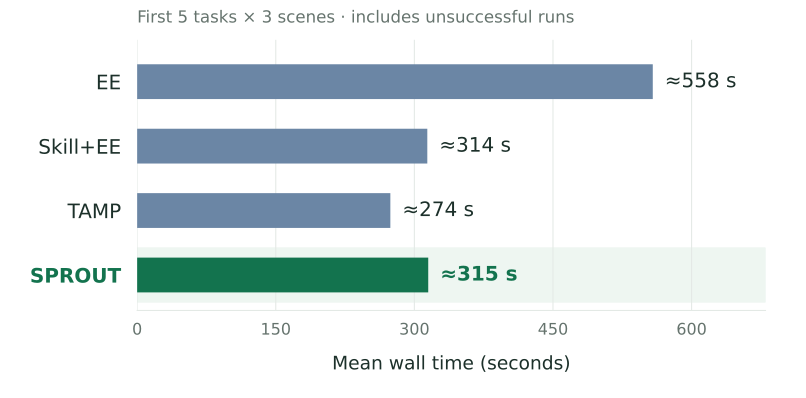
Five shared tasks · three scenes each · lower time is better
 Expand chart
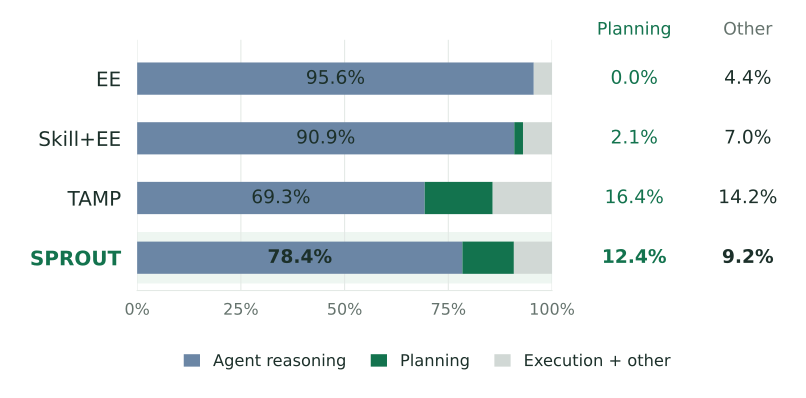
Reported time allocation · Figure 6
 Expand chart
Approximately 44% lower mean wall time than EE on the five shared tasks. SPROUT also completes 6/9 instances of toast preparation, drawing, and tool retrieval, which the other interfaces do not solve. The flexible specification lets the agent add motion detail when needed and return to high-level goals when it is not.
TAMP is faster on the shared tasks at 274 s, but cannot express the three more complex task types in this evaluation. Flexibility and task coverage matter alongside runtime.
Source: Section 5.2 and Figures 5–6. Episode means include unsuccessful runs. The time-allocation chart reproduces the paper’s reported percentages; it is not used to infer absolute planning times or per-replan latency.
| Interface | Mean wall time |
|---|---|
| EE | ≈558 s |
| Skill+EE | ≈314 s |
| TAMP | ≈274 s |
| SPROUT | ≈315 s |
| Interface | Agent reasoning | Planning | Execution + other |
|---|---|---|---|
| EE | 95.6% | 0.0% | 4.4% |
| Skill+EE | 90.9% | 2.1% | 7.0% |
| TAMP | 69.3% | 16.4% | 14.2% |
| SPROUT | 78.4% | 12.4% | 9.2% |
The shared tasks are stacking blocks, stowing utensils, discarding bottles, aligning tools, and reorienting mugs. Figure 6 does not separately specify its aggregation basis, so its proportions are shown independently from the five-task means. TAMP’s percentages sum to 99.9% due to rounding.
| Task | EE | Skill+EE | TAMP | SPROUT |
|---|---|---|---|---|
| Block stack | 3 | 3 | 3 | 3 |
| Utensils upright | 0 | 2 | 0 | 1 |
| Discard bottles | 1 | 3 | 3 | 3 |
| Tool alignment | 0 | 0 | 1 | 1 |
| Reorient mugs | 0 | 1 | 2 | 2 |
| Toast breakfast | 0 | 0 | 0 | 2 |
| Whiteboard smiley | 0 | 0 | 0 | 1 |
| Tube tools | 0 | 0 | 0 | 3 |
The evaluation uses Isaac Sim with an FR3 and Robotiq 2F-85 gripper. Scene information and the agent are shared across conditions. TAMP cannot express the final three task types; these instances count as failures in its overall success rate.
Scope and limitations. This is a 24-instance evaluation. SPROUT does not solve every scene, and a restricted planner can be faster on tasks within its domain. Execution reliability, computation allocation, and real-world deployment remain directions for further work.
Agentic failure recovery
Execution feedback lets the agent identify what needs to change. It revises the relevant part of the task, and SPROUT replans the remaining geometry and motion.
This video could not load. Open the MP4.
The first rod interaction leaves the red block inside the tube. Execution observations give the agent feedback on the gap between the intended and observed result.
The robot withdraws, reapproaches, and regrips the rod. A renewed push frees the block. The agent can revise a goal, constraint, or motion detail while the planner completes the rest.
With the block accessible, the robot sets the rod aside, grasps the block, and places it on the plate. Recovery is part of the episode.
Efficient recovery through focused replanning. The agent specifies the necessary change instead of spelling out every grasp, approach, and robot trajectory again. SPROUT supplies those remaining choices using model-based search and pooled numerical queries.
The clip illustrates the physical retry and continuation. The agent–planner explanation follows the system design; individual replanning latency is not measured in the video.
This video could not load. Open the MP4.
This video could not load. Open the MP4.
Rollout gallery
Stack, reorient, stow, draw, and use tools across different scenes. These selected simulation rollouts show the behavior behind the tasks, including intermediate adjustments.
15 videos
This video could not load. Open the MP4.
The robot clears fruit, a spoon, and a cup from a whiteboard, then grasps a pen and draws two eyes and a curved smile.
Download clipThis video could not load. Open the MP4.
Bread is transferred from a rack into the toaster; the robot operates the toaster and transfers the toast to a plate.
Download clipThis video could not load. Open the MP4.
A long rod pushes a red block out from a transparent tube. The rod is set aside, and the block is placed on a plate.
Download clipThis video could not load. Open the MP4.
Blue, green, and yellow blocks are stacked onto a red base block.
Download clipThis video could not load. Open the MP4.
Three cups are repositioned and made upright among other objects and a raised box.
Download clipThis video could not load. Open the MP4.
Two green kitchen utensils are picked up and placed into a ceramic vase. The second utensil is regrasped before placement.
Download clipThis video could not load. Open the MP4.
The robot moves three blocks off a tilted whiteboard, then uses a pen to draw on the cleared surface.
Download clipThis video could not load. Open the MP4.
The robot loads the toaster, operates its side control, then transfers the toast to a plate from a different scene arrangement.
Download clipThis video could not load. Open the MP4.
The robot repositions and regrips a long rod among tabletop objects, pushes a red block from a transparent tube, and places it on a plate.
Download clipThis video could not load. Open the MP4.
A four-block tower is assembled beside a tall wooden obstacle.
Download clipThis video could not load. Open the MP4.
Two cups lying on their sides are picked up and reoriented upright.
Download clipThis video could not load. Open the MP4.
Two differently oriented hammers are picked up, rotated, and placed in a shared alignment.
Download clipThis video could not load. Open the MP4.
The robot places small bottles into a gray square bin among other containers.
Download clipThis video could not load. Open the MP4.
The robot transfers small bottles into a blue crate in a cluttered arrangement.
Download clipThis video could not load. Open the MP4.
Two small bottles are picked up and dropped into a round gray bucket.
Download clipClips are shown at the supplied 3× speed. These examples are a selected gallery; aggregate success rates above include all evaluated scenes. Playback duration is not a measure of agent reasoning or planning time.
Citation for the anonymous manuscript.
@misc{anonymous2026sprout,
  title = {Generalized Planning Interfaces for Agentic Robotics},
  author = {Anonymous Authors},
  year = {2026},
  note = {Anonymous manuscript}
}